Showing posts with label home brew. Show all posts

Thursday, April 18, 2013

An Experiment with Oatmeal

With price of malt increasing, I've started supplementing my grain bills by adding quick oatmeal to my mash.  Prices at my local home brew shop have gone up 25% in the past year, and with the cost of shipping outside the 48 contiguous states, ordering online doesn't seem like a cheaper option (and I like supporting a local business.)

With my last brew (the Mosaic IPA that gave me all that trouble with marbles in the fermenter), I pushed the oats to a level I had not previously touched outside of oatmeal stouts.  This IPA was mellow on gravity, just 1.050, but I used oatmeal to make up ~10.5% of my grains.  It's important to mention that 1.002 of my gravity points were from table sugar.  To keep the oatmeal from becoming a flavor diluting filler adjunct, I toasted it in the oven for an hour at 300 degrees F.  Then I let the oatmeal sit for a week.  I read it can give a harsh flavor if it's added to beer immediately after toasting.  From previous experiments, I found that toasting the oatmeal like this gave me flavor contribution that tasted to me somewhat  like biscuit malt, but with much less intensity by weight than the biscuit malt.

I only bottled the IPA a couple of days ago, but it's already fairly clear.  I was a bit concerned that the extra protein from the oatmeal may give a haze to the beer, but it seems to not have been a problem.  The glass in the photo below has a lot of condensation, but I rubbed a streak of it away near the base of the glass.

As far as flavor, the beer has a nice malty flavor that doesn't seem diluted by the oatmeal at all.  Of course I did use Maris Otter as my base malt.

In the future, I'm planning to push my level of toasted oatmeal a little more, taking it up to 15% of my grain bill in an even lower gravity beer.


Sunday, April 14, 2013

Marbles in the Better Bottle

Today I racked a tasty new IPA out of my Better Bottle that I had dry hopped with three ounces of Mosaic hops that I put in a hop bag.

This time I had tried improving my dry hopping by putting marbles in the hop bag to sink it into the beer, hopefully getting more contact with those tasty Mosaic hops and my beer.  The marbles didn't turn out to work so well.  I dropped 12 ounces (by weight) of marbles into the hop bag and the bag still floated.  When I tried to remove the hop bag after racking the beer out of my Better Bottle, it was very difficult.  Usually, I can just pull the bag and it slips out of the Better Bottle.  This time, the marbles ended up pressing together, making it impossible to simply pull the bag out.  I spend half an hour with the open end of the hop bag hanging out of the better bottle, digging out the dry hops and marbles with a long spoon.  If I had done this in a glass carboy, I don't think I would have ever gotten the bag out.  I don't think using marbles to weigh down a dry hop bag is such a great idea unless you're using it in something with a large opening like a plastic bucket.

Luckily, I tasted my hydrometer sample and the beer was great.  Mosaic is a tasty hop.

Thursday, April 11, 2013

Temperature Control Update

I got my Ranco today.  It works great, not much different from my thermostat (except that the Ranco actually works), but it feels much more sturdy.  I saw some people leaving their cables dangle freely from the hole in the bottom of the box, but I opted for a cable connector (didn't like the idea of cables being held into place by nothing the terminals in the box).


Sunday, January 20, 2013

Autosiphon Dime Fix Update; BIAB Water Absorption Rate

I just brewed today and experimented a little with my autosiphon.  In my last entry, I mentioned that I had fixed a problem with the little valve thing popping out of my autosiphon by dropping a dime into the larger tube.  Today, I tried using a nickel, but it kept sinking and blocking off the flow of liquid.  Then I tried two dimes, which seemed to get the siphon started faster.

Besides that, I noticed that the absorption rate of liquid using my dunk sparge brew in a bag method was 0.5 Gal/per Lb of grain (sorry I don't have a metric conversion). 


Wednesday, December 19, 2012

Autosiphon dime fix

After only about five brews, I've been finding that the little valve flap thing in my autosiphon keeps popping off.  At first, it seemed to only happen when I sucked up hop matter into the autosiphon, but last night the little thing popped out while I was running sanitizer through it.  I had wort chilling, so I didn't have time to spend popping it back in with a pair of tweezers as I've done before.  So I tried dropping a dime in the siphon as I've read on the internet.  It didn't work as well as the little plastic flap, but after a few strokes I did get a siphon started.

In summary, fixing an autosiphon with a dime does work.  (I have the half inch model of the autosiphon.)

Sunday, October 21, 2012

Brew in a Bag Session 2

I did my second brew in a bag session today.  It was only four hours from the time I started heating my strike water till my my 65 degree F wort was transferred to a carboy and I finished cleaning up.  I did cut my boil time to 45 minutes.  If that doesn't lead to any dms  issues, I may just shorten up my normal boil time (I usually don't have a 60 minute hop addition anyway).

This batch may have given me an issue with efficiency (only 68%), but I may have messed up my measurement by drawing a sample from near the top of my kettle while I was chilling.  (I usually draw a sample at the end of my boil before everything gets stratified.)  My first brew in a bag batch had a 76% efficiency, so I think I just took a bad sample this time (especially given that this was a lower gravity beer).

I've added some photos this time to show how I executed a brew in a bag session in the kitchen of my condo.


This is my brew kettle just after adding my grains to my strike water.  I used the same formula for calculating my strike water as I did with a water cooler mash tun and it worked perfectly.  That is of course with a towel around my kettle for insulation.  

This is a second pot (5 gal.) that I  put my bag of grains into after removing it from the brew kettle for my mash.  I left the bag in here for about ten minutes and stirred up the grains.  I had an over flow last time.  Now I estimate that for a normal gravity beer, I can only have between 2-2.5 gallons in my 5 gallon "dunk sparge" kettle.  


After my "dunk sparge," I removed my grain bag to a large stainless steel mixing bowl where I caught some extra wort dribbling from the grains.  

Given my experience with this second brew in a bag session, I think I will be using this as my primary all-grain brewing method.  Finally, in my last post, I noted that this method produced very cloudy wort. This time, was no different.  I had a lot of break material in the bottom of my kettle after chilling.  But to keep from losing too much wort, I opted to use a hop sack.  I rarely use hop sacks, but I think I will be using them for brew in a bag.  So far, I think this is the best all-grain method I've found for brewing in my small apartment kitchen.  It's also pretty much as fast as knocking out an extract with specialty grains batch.  

Saturday, October 20, 2012

Brew in a Bag Experiment

My local home brew shop started carrying large nylon mesh bags big enough for brew in a bag.  I tested it out  on my last brew with 13 lbs of malt and the seam on the bag ruptured in a few spots.  Besides the ruptures, which I've patched with some nylon thread, it was much easier than mashing in my water cooler mash tun.

If you've read my post on doing a full wort boil on a glass top range http://greatermonkey.blogspot.com/2012/04/full-wort-boil-on-glasstop-electric.html, you'll see I use a towel wrapped around my brew kettle to help me get 5.5 gallons of wort from mashing temperature to a boil in 20-25 minutes.  That towel worked great at retaining heat during the brew in a bag mash.  I only lost one degree F on a 1 hour mash.  The wort came out a lot cloudier than with my water cooler mash tun, but the beer still cleared out nicely after fermentation.  With the time I saved by not draining and then washing the mash tun, I think I may prefer mashing with brew in a bag to mashing in my water cooler mash tun.

I'll be testing out brew in a bag again tomorrow with my repaired and reinforced mesh bag.

End of the 2012 Hop Growing Experiment

My experiment on growing hops in the tropics is over and I didn't get any cones.  This year was hot and windy and I had trouble keeping the leaves on the plants from drying out without making the soil too wet.

I just dug up my rhizomes and stuck them in the fridge.  I'll probably give it another shot next year and hope for better weather.

Sunday, May 6, 2012

Hops Update

After dropping the twine on my Nugget bines a third time, one of the the bines has again reached the top of the twine.  I think at this point I'm going to let the top of the bine start slumping over.  I read that would encourage the growth of laterals.  I think that the length on that Nugget bine is at approximately 15 feet now.  I think that's pretty good for a bine growing on a condo balcony.

The stumpy Cascade seems to have given up and shriveled to death.  That sucks, but that's the reason I bought two  rhizomes of each variety.

The surviving Cascade is still shorter than the two Nugget bines, but it's started shooting out new horizontal growth.  I hope those are the laterals I've been reading about.

Tuesday, May 1, 2012

Cheap Fermentation Temperature Control Update

The modifications I've made to my temperature control (putting my cold water reservoir in my mini refrigerator) are not working out well.  So far, the control seems to have trouble keeping the beer below 68 during fermentation.  That isn't so bad for the Belgian blonde I'm doing right now, but I like some of my other beers to ferment cooler.  I may consider looking for a larger reservoir.

I'm also considering changing the placement of my temperature probe.  Right now I have it attached to the carboy below the first couple inches of beer.  But I've notice my temperature readings near the bottom of my carboy are about 8 degrees cooler than near the bottom couple of inches.  Something to look into later.


Hop Update

A couple of days ago I had to add about five extra feet to the twine on my Nugget hops.  The Nuggets are continuing to grow vigorously.  The healthy cascade is still growing rapidly, though not as impressively as the Nuggets.

Unfortunately, the sickly Cascade is looking like a goner.

As for the fungus gnats, I've been letting my soil dry until I see the leaves at the top getting a little crispy before I water.  I've also been watering with the garlic solution.  The gnats aren't as plentiful as they were, but there's still a lot of them buzzing around my pots.  I've also started putting out little dishes of vinegar mixed with a few drops of dish soap around the plants.  The vinegar traps look like they're catching hundreds of gnats, but they don't stop coming.  I didn't want to use poison on my plants, but I'm starting to reconsider now that I'm seeing gnats buzzing around my house (where they might land in my beer).

Sunday, April 22, 2012

Hop Update

I've recently noticed a bunch of fungus gnats (identified from a google image search) coming out of my hop containers.  I've decided to wait longer between waterings and apply a garlic water recipe I found on the internet (head of garlic soaked in water for 2 days, then strained and diluted to 1 gallon).  I also added chilis to the water because I read that was supposed to repel other pests.  I'll see how it works in a few days.  The plants seem to be doing fine despite the bugs, with the exception of my sickly Cascade.

Full Wort Boil on a Glasstop Electric Range

This is 5.5 gallons of wort that I got to a boil on my glasstop electric range.  After I got the first and second runnings into the kettle I believe my wort was at around 155 degrees F.  With this towel secured around the pot, I got to a boil in approximately 22 minutes.  

When I first started trying to do all grain I had stuck to 4 gallon batches that barely fit in my 5 gallon pot.  I wanted to be able to do 5 gallon batches, but I wasn't sure my stove could get all that wort to a boil.  I ended up buying this 7.5 gallon pot with the self-justification that if I couldn't get the full 5 gallon batch to boil, I could at least do my 4 gallon batches without having so much wort splashing out during the boil.

I was surprised at how well this towel wrap improved the efficiency of my boil.  When I did my first batch of extract, it took me 40 minutes to get a mere 3.5 gallons of wort to a boil from 155 degrees F.  It seems like the towel made a huge difference.  I left a couple of inches between the towel and the bottom of the pot to avoid having the towel burn.  I also watched the pot in case the towel slipped (which it didn't).

I should note that I brought this to a boil with a lid on, which I removed when the wort got up to around 208 degrees F.  I gotten my last two 4 gallon batches up to a boil with the lid on and not noticed any DMS character, so I went ahead and did it on this beer.  This one's still in the fermenter, so I can't be sure there weren't any problems caused by the lid.   

Wednesday, April 18, 2012

Hops Growing Update

There hasn't been much going on in the hopyard so there hasn't been much to post about.  Everything is still growing bigger, except for that stumpy Cascade (which still looks small and sickly).  You can see the stumpy Cascade on the right side of the photo.  

As mentioned before, I was using the ajustable trellis system described in a BYO article (http://www.byo.com/component/resource/article/1926-growing-hops-in-containers).  Today, I saw that the Nugget plants were reaching the top of my trellis, so I decided to drop them.  I didn't want the bines flopping in the wind because it's been uncharacteristically windy for me this year.  To avoid having lots of slack bines flopping around in the wind, I let the lower part of the bines flop over the edges of my growing containers.  Then, I attached the top of the twine hanging over the bucket to the twine at the point where I had attached to base of the twine to the container.  This allowed me to leave the lower part of the twine hanging loose, while pulling the upper part of the twine snug.  I tried to get a picture of what I did below.


Tuesday, April 17, 2012

Temperature Control Upgrade?

I've just pitched yeast into an ale using my newly modified temperature control system.  I've gotten rid of the cooler of ice and water and replaced it with milk jug in a mini-refrigerator.  I have the same pond pump set up running water out of the milk jug.  To run the tubing and power cable for the pump out of the refrigerator,  I put a slit in the top of the magnetic strip on the refrigerator door.  I'm starting it off easy with a Belgian golden ale recipe that I wanted to ferment on the warm side, 70 degrees F.

My cheap thermostat controller got knocked over while I was setting everything up and one of the connections I soldered got torn out.  I jammed the wire back into the heat shrink and taped the wires to the  thermostat so they couldn't move.  That was tiring, so I'll add pictures later with an update on the performance of this new system.  If it works, I won't have to plan changing ice packs into my schedule.

Wednesday, April 4, 2012

Bottle of Jolly Pumpkin La Roja

I drank a bottle of Jolly Pumpkin La Roja a few days ago and decided I should dump my last jar of starter wort over the sediment and see if it grew.  It's looking nice and active today.


Friday, March 30, 2012

Hop Experiment: Three Weeks

It's about three weeks since I planted my rhizomes.  The last rhizome to sprout was this Cascade, which seems to be moving along very slowly for some reason.  I'm glad I bought a second Cascade because this one is lagging compared to the other plants.  The sprouts also look strange compared to the sprouts from the other plants.

In comparison to that disappointing Cascade,  this one seems to be moving along nicely, although slower than the Nugget plants.  It's approximately 13 inches right now.

The Nugget plants continue to be the most impressive, with the longest bine (below) at approximately 25 inches.


You may also be able to see that I've rearranged the Christmas lights.  I have them hanging from my stakes so that the string runs vertically behind each bine.  I've also moved the grow bulbs (of which I have two in aluminum light fixtures) up the stakes so that they're above the top of the Nugget plants.  

Saturday, March 24, 2012

Hop Experiment: Two Weeks

It's been about two weeks since I put my rhizomes in the ground and they've finally all put up shoots.  This Cascade was the last to put something up.
 The Nuggets (below) are way ahead of the Cascades.  The bines on the Nuggets were getting long enough to bend to the side, but weren't long enough to reach the twine I had secured to my containers.  I ended up tying an extra lengths of twine to the pieces I had already strung up.  Then I wrapped the bines around those extra pieces of twine.
 This (below) was the first of my two Cascades to put up shoots and it's already way ahead of the second Cascade.  I'm a little concerned that it's looking wispy compared to the Nuggets.

At this point, I have each of my four rhizomes in it's own five gallon bucket with commercial potting soil.  I'm using an adjustable trellis system similar to the one described in this BYO article (http://www.byo.com/component/resource/article/1926-growing-hops-in-containers), except that I'm limited to a 6.5 ft stake.  I would have preferred to use a larger stake, but that was about as tall as I could make them while still being able to move the plants.  

Monday, March 19, 2012

Cascade Sprouts

I noticed some sprouts finally coming out of one of my Cascades today.  The Nugget rhizomes have both already have about six inches of growth with nice shapely leaves.  I was concerned about the amount of light coming off of the two LED grow bulbs I initially set up to supplement my daylight, so I've added a string of 60 white LED Christmas lights I had.

Thursday, March 15, 2012

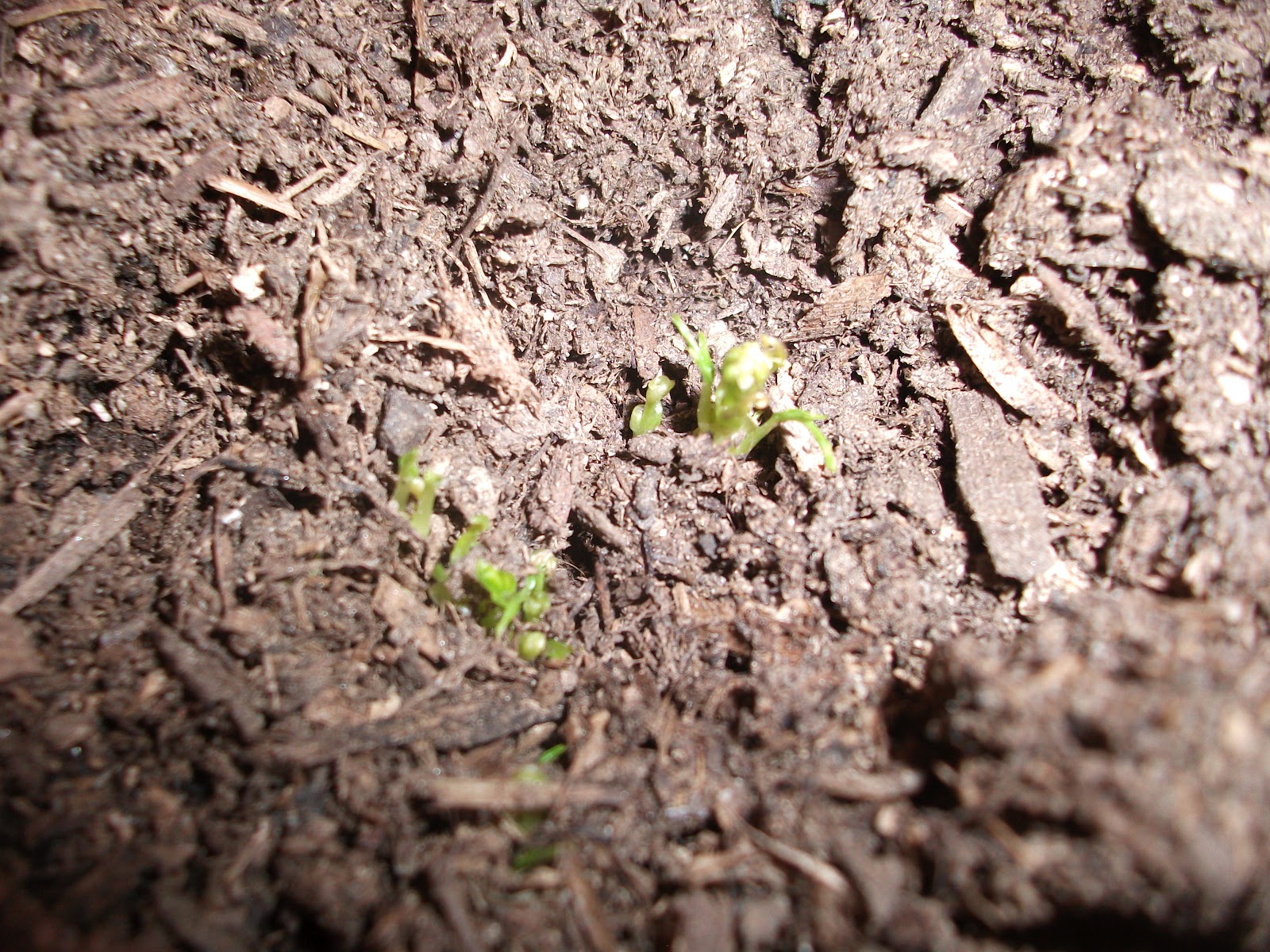
More Nugget Shoots


The second Nugget put up a shoot today, but still nothing from the Cascades. The first nugget has also put up some new shoots. Now that I have some shoots, I've put a few lights on a timer to come on in the morning before sunrise and again after sunset to try and mimic fourteen hours of light. I had been thinking about supplementing my short tropic days with artificial light and decided to try it after reading a blog about growing hops in South Africa here http://www.heydenrych.info/hop_growing.html.